27 February 2013

Week 22 - Mancora, Vilcabamba (Peru, Ecuador)

After Rhys had finished his first day of Spanish homework he was too fried to go out for dinner so I ended up heading into town myself and ate at a lovely little café away from the blaring bars along the beach road with a good book and cuba libre for company.

Our second day of Spanish classes started at 9am for 3 hours. We couldn’t have picked a better location, sitting in the hostel common area with views over Mancora and out to sea and a 4 month old puppy called Lola to distract us. (Lola became our best friend after staying at the hostel for 6 nights and took a liking to running into our room and stealing anything she could find from toothpaste to socks, flip flops to Rhys’s pants and running off with them to the reception area. One morning when we’d slept with the door open because of the heat she came in to wake us up by biting Rhys’s feet, oh how I laughed!). After Spanish Rhys headed into town for tacos while I studied and we spent the rest of the day relaxing outside our cottage in the sun. We headed to a Mexican restaurant for dinner and some happy hour mojitos.

Spanish lessons on day 3 started getting more complicated with past tenses and the like. It’s amazing how tiring 2.5 hours of studying a language can be. Before the lesson, Rhys stayed in the room playing computer games while I went to the beach to watch the surfers and to make the most of the sun – every day we were in Mancora it was blue skies and in the region of 32C. I headed into town for dinner by myself again while Rhys played on the computer and went to a little place serving BBQ fish.

We were both glad when it got to the final day of Spanish lessons, I don’t know how people do 4 hours a day for 5 days, it was really hard. The last day was mostly conversational though so we started to put what we’d learnt into practice, role playing going to the market and buying bus tickets. I spent the morning before the lesson on the beach while Rhys stayed in the room with the computer but that afternoon Rhys came out with me for a walk around town to buy bus tickets and we had a super healthy dinner back at the hostel of red wine and Doritos.

Our last day in Mancora was Spanish free. On the advice of the girl working at the hostel we caught a local bus to Los Organos, 15 minutes south and then a tuk tuk the last couple of kilometres to a working fishing pier at a place called Nuro. Nuro is a small handful of smart houses along a desert like strip of beach. We paid 5 soles (£1.25) to be allowed on the fishing pier and to be able to jump off and swim with the green sea turtles. It was incredible. There were only a few other people there as it’s not in any guide books (yet) and most of the time it was just me and Rhys in the water. At one point when the fishing boats came in, there must have been about 20 turtles swimming around us and nudging us, each with a shell a metre or more across. They were after the fish discards that the fishermen were throwing in – so it smelt pretty bad and you didn’t want to get the water in your mouth but it was so so worth it to be able to swim with so many turtles. After the turtles we got a tuk tuk back to Los Organos and had lunch at a restaurant on the beach before hiring surf boards for an hour. The waves were not for beginners, when you caught a wave but lost it before you could stand the power of the waves made you feel like you were in a washing machine, it was a bit scary. That night to say goodbye to Mancora we went back to the Mexican restaurant and ordered a ridiculous amount of BBQ chicken wings. 

We were up early on Sunday for a direct bus to Loja in Ecuador, only when we got to the bus terminal we were told there was a problem with the bus and it wouldn’t be running so instead of the nice direct bus we had treated ourselves to, we were taken to the Eppo bus terminal and put on a bus to Sullana where we had to get a tuk-tuk across town to another bus office (the address of which no one in Mancora seemed to know). We dug around for the last few Soles we had to pay for the tuk-tuk before being told by a woman at the bus office that we couldn’t board the bus without paying 50 cents. We didn’t have 50 cents, just a 50 Soles note that they wouldn’t change. Eventually they accepted a US dollar bill and let us on to the bus. The border crossing was thankfully easy although we were running extremely low on water. Rhys ended up running off the bus at a stop on the Ecuadorian side to grab some from a stall. The bus finally arrived in Loja and we bought a ticket to Vilcabamba, 70 minutes south. Rhys went to get cash and got chatting to some people and we ended up missing the bus and changing the ticket for the next one 30 minutes later. Arriving at Vilcabamba in the dark there were no taxis at the bus station and we were told there would be no taxis at this time of night. After despairing for 15 minutes a taxi pulled up and we finally made it to Izhcayluma, a hostel retreat 2km out of town owned by German brothers. We were so happy to get there and the guy on reception was kind enough to ask the kitchen to stay open for us as we hadn’t eaten all day. The Bavarian goulash was incredible. After dinner we headed to bed to recover from the journey.

The next day we had a chill day. We had pancakes for breakfast and a huge fruit salad before walking into town to explore. There’s not much in Vilcabamba itself, people tend to go there for the hikes and the horse riding in the surrounding national parks and hills. It is however full of American expats. We shared a BLT for lunch and had some anti toxin juices (yuck) before buying a carton of wine and some supplies for the following day and heading back to the hostel. We moved rooms into a huge 6 person, 2 floor dorm and spent the afternoon relaxing in the hammocks overlooking the tropical gardens, drinking wine and playing cards with our dorm mates. After dinner (more Bavarian fair, this time stroganoff) we headed to the bar where we played pool against the owner and his friend and Rhys met his match in table tennis. Rhys also managed to get bitten by a dog (no actual damage to him, just his jumper) when he startled the old dear while she was asleep.

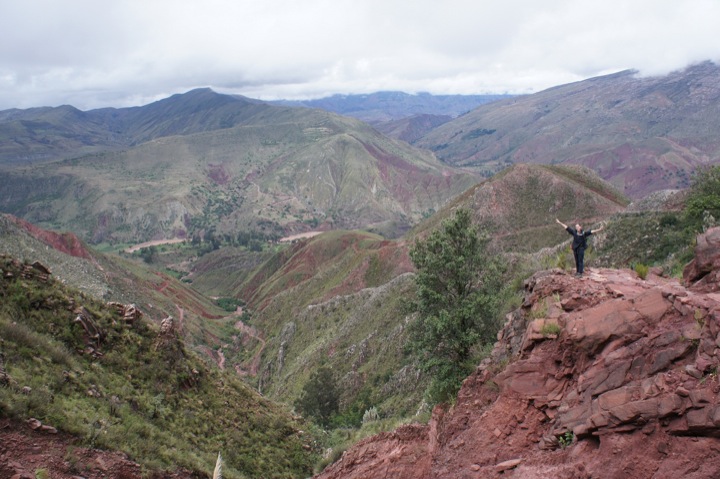
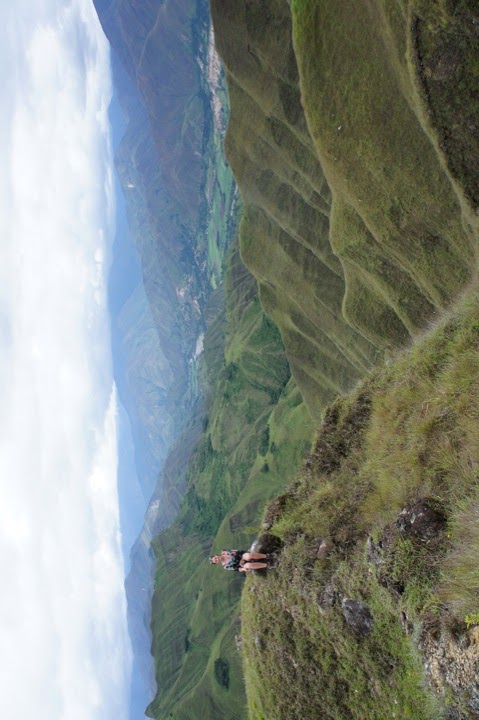
The next day we decided to go on a hike in the surrounding hills. The hostel has mapped out about 8 walks and gives you a print out of the trail with detailed instructions of where to go. As you walk around the trail they have even gone to the hassle of spray painting boulders and branches so you can’t get lost. The walk started following a creek across the valley before joining a country road which we followed up hill for about an hour and a half. Although not the prettiest bit of the walk it’s always nice to actually see how the locals live, to see their houses and schools and the like. After the road met the new highway we started climbing, under a barb wire fence with permission of the land owner and through a local farmers pastures until we reached the ridge line. We spent about an hour then just walking along the ridge at the top of two valleys, it was stunning although a bit precarious in places. The rain started just as we started our descent and all of a sudden the path was slippery and we had to speed up and really concentrate to get down into the river bed without any injuries. The last part of the walk followed the river bed for an hour, ducking under barb wire fences and climbing over tree branches as we went. The walk was supposed to take about 5 hours but we were back at the hostel in 3.5 hours. We spent the rest of the day relaxing before playing cards and a new game Dobble with our dorm mates. Turns out Rhys gets quite raucous playing Dobble.
Walking in the hills around Vilcabamba.
Rhys walking along the ridge, Vilcabamba.
View from the restaurant, Izchayluma, Vilcabamba.

20 February 2013

Week 21 - Huaraz, Huanchaco, Mancora (Peru)

Early during our first day in Huaraz, two girls checked into our dorm, Priya and Ash, and said they’d booked on to a 10am tour to Llanganuco lake. Since we quite fancied visiting the glacier lake too we decided to join the tour. Big mistake. After a 3 hour bone shaking drive via Carhuaz and Caraz we arrived at the Huascaran national park by the shore of a small and not overly impressive lake. As the guide only spoke Spanish we had no idea where we were and what we were supposed to be looking at and thought it was a break to get some lunch. Back in the minibus our next stop was the actual lunch stop where we had to wait for over an hour for everyone else to eat. The tour continued driving up into the valley and into Yungay before stopping at the site of a memorial park where an avalanche had wiped out a village before stopping at a cemetery, a dulce de leche shop and a pottery barn. We were glad to get back into Huaraz, it wasn’t quite the scenic lake trip we expected. Only then did we realise there was a lovely 2 hour walk at the lake that would have taken us around to see the second lake. Partly our fault and partly a rubbish tour, they didn’t even give you time to walk to the second lake.

Anyway, that experience and a quick explore of the area near the hostel made up our minds to get out of Huaraz rather than staying to do any further hikes (we’d fancied the Laguna 69 hike but couldn’t bare the thought of doing the bone shaking drive into the mountains again). We booked a bus ticket out the next night then headed into the centre for pizza to celebrate. Huaraz isn’t a pretty town, it’s very modern, busy, dirty and dusty.

As there aren’t any particular sites in town other than another cathedral we spent the day waiting for our bus in the hostel on the roof terrace where we probably had the nicest views of the city anyhow. The bus journey back down to the coast wasn’t half as scary as on the way up although pretty much everyone on the bus was struggling with travel sicknesses. We had a bit of a surprise when we arrived in Trujillo at 4:30 in the morning rather than at 6:30 per Lonely Planet. We jumped straight in a taxi and headed to Huanchaco, a beach resort about 5km out of Trujillo, where we checked in to our room and went to bed.

That day, and the next day were chill days. We walked along the beach, ate in the European Chocolate Café, drank £1.25 Mojitos and generally watched the world go by. It’s not the most attractive of beaches (Rhys found a syringe) so we made the decision to keep moving north to Mancora and booked a night bus for our third day.

On the third day we caught a bus to Chan Chan, the largest Pre-Colombian city in South America and the capital of the Chimu Kingdom (at it’s peak in the 15th century before falling to the Incas). Back in town we spent 3 hours sitting on a concrete bleacher watching a BMX and skateboard competition. Some of the BMX riders were incredible, these guys just have no sense of self preservation. We ate in the Chocolate café again that night (having also had lunch there!) before heading in to Trujillo to catch our bus.

We arrived into Mancora at around 7am and walked up the hill to our hostel. It’s beautiful. We’re perched on the hill top with views over the beach and town. We have our own little bungalow with a hammock and chairs out front. The worst of it is the noise from town carries and it’s pretty loud here at night and every time you go into town you have to climb the hill to get back to our little haven. Mancora is extremely touristy with bars, restaurants and markets everywhere but it’s exactly the kind of place we’d been looking for to stop for a while with a beautiful beach, blue skies and every day sunshine. All up we’re intending to stay for 6 nights. The first day we explored and sat by our bungalow enjoying the view before going out to an expensive steak restaurant for a treat.

Today we had surf lessons at 10am. Before we even made it into the sea Rhys had kicked a rock and taken a chunk out of his toe and on his first attempt at surfing he hit the rocks in the shallows and took a chunk out of the other foot. After that though he was awesome. It took me a little longer but I got there in the end and our teacher (who only spoke Spanish) was very persistent and wouldn’t give up on me until I got it. After an hour we were knackered and headed back up to our hostel to bandage Rhys’s feet.

This afternoon we had a Spanish teacher come to our hostel for a private lesson. It was so nice to actually use my brain and learn something, being on holiday for 5 months does have its downside… After 2 hours we were fried, we’ve booked in for more lessons over the next 3 days. Rhys is sitting doing his homework now so we can go out for dinner (I did mine hours ago while he was playing Pokemon, no suprises there).
Huascaran National Park, near Huaraz.
Chan Chan, near Huanchaco.
Watching the BMX competition, Huanchaco.
The view from our bungalow, Mancora.

13 February 2013

Week 20 - Arequipa, Huacachina, Paracas, Lima (Peru)

We arrived in Arequipa at 6am and grabbed a cab to the hostel we had booked only to be told we couldn’t check in until 11:30am. We curled up in the communal area to watch Sons of Anarchy on our laptop and wait. Once checked in we headed in to town to explore and to search for a Spanish school. Arequipa, although still beautiful, didn’t live up to Cusco. It’s very busy and they love using their car horns. After checking a couple of places and realising we really needed to start a course on a Monday we gave up (we’ll try to find somewhere further up the coast). Rhys headed off to find Burger King for lunch and I sat on a little terrace in a café on a pedestrianised street and met him back at the hostel later. That afternoon I headed out to visit the Jesuit Inglesa de la Compania, a church with an incredibly ornate façade and with a chapel covered in murals of tropical flowers, fruits and birds. Back in the main Plaza I stopped for coffee and cake before heading back to the hostel to find Rhys. For dinner we headed back to the cobble stone pedestrianised street behind the cathedral for tacos and mojitos.

The next day we walked to the Monasterio Santa Catalina, a convent occupying a whole block of the town surrounded by high walls. Founded in 1580, 30 nuns still live there but a large area of the complex has been opened to the public. Lonely Planet calls it ‘meditatively mazelike’ and you can’t help but agree. With it’s winding streets and bright blue and terracotta walls and red geraniums and orange trees it really is a peaceful haven. After a coffee in one of the courtyards we headed back to the hostel before our night bus to Ica.

We arrived into Ica on time and caught a cab straight out to the oasis town of Huacachina a couple of kilometres west. The whole village comprises of a small lake and about two streets but the draw is the huge sand dunes that surround it. After checking in and chilling at a bar with a pool we booked a sand dune trip for that afternoon. We climbed onto and strapped into a dune buggy and headed into the dunes for a rollercoaster ride. The buggy dropped us off at a couple of spots and dished out sand boards and we spent the next hour or so shooting down the dunes either lying or standing on our boards without anyone in our group getting any more serious an injury than a bit of sand burn. That night we ate BBQ and played dice with a couple of people from our trip.

Since Huacachina was pretty quiet and after sand boarding there wasn’t too much to do we decided to head further north to Paracas, 4 hours away. After check in and a quick exploration of the tiny town, Rhys recruited two of the other people from our dorm and we headed to the sea front for dinner and on to a bar with live music for cocktails. 

When we woke we were escorted to the dock and on to a boat for a trip out to Islas Ballestas, nicknamed the ‘poor mans Galapagos’. After a brief photo stop at the ‘Candelabra’ – a giant etching in the hills, the boat continued and we spent about an hour cruising around the islands arches and caves, watching the noisy sea lions and the thousands of birds, mostly pelicans, cormorants and boobies (although we were a little disappointed by the lack of blue feet). After heading back into shore, and spending half an hour queuing for our boat to dock, we went back to bed for a quick nap to sleep off the previous nights cocktails before the afternoon tour of the national park. The park was a big desert filled reserve and other than a stop to look at shell fossils, it wasn’t really worth the visit. We stopped at a few view points and an incredibly busy cove and a supposedly red beach.

The next day we were on the move again and headed up the coast to Lima. Although we’d hoped not to have to stop there the bus times meant it was easier to spend a night. We checked into a quiet hostel in Barranco, a bohemian district to the north with lots of colonial houses and restaurants and bars. By the time we got there it was late afternoon so we headed out to an amazing sandwich shop where we caught the end of the football on TV. On the way back to our hostel we stopped at Starbucks for some home comforts - frappuccinos and muffins. 

Our bus out of Lima was at 11am. The only scary bus ride we’ve had since we’ve been away. On leaving Lima on the freeway the driver had to slam on the brakes when we came across about 60 sandbags sprawled across the road and 4 police man trying to shift them. Another truck didn’t manage to stop in time and went straight over them causing the police man to jump out of the way, the truck pulled up a hundred metres further down the road with smoke coming out of it, we carried on. Then we turned off the freeway and started the winding road up into the mountains. It had rained and there had been a lot of landslides with rocks lying all over the road so we had to keep weaving into the incoming traffic lane on blind bends to avoid them, veering too close to the steep drop for our liking. Then there was a tree in the road that we had to stop for and call in so they’d come and clear it away. We stupidly booked the front seats on the top deck thinking we’d enjoy the view but seems being able to see what was happening made it all the worse. Arriving into Huaraz was a relief more than anything. It was late at night so we hailed a cab and checked in to our hotel.
Jesuit Inglesa de la Compania, Arequipa
Monasterio Santa Catalina, Arequipa.
Fountain in Monasterio Santa Catalina, Arequipa.
Sand dunes, Huacachina.
Candelabra, off the coast of Paracas.
Thousands of sea lions, Islas Ballestas.
Islas Ballestas.

6 February 2013

Week 19 - Cusco, Inca Trail (Peru)

Rhys woke up with a hang over after beer pong and spent the day relaxing playing Pokemon. I headed into town to join a free walking tour. I highly recommend it. Rather than being a standard city tour the guide takes you to non-touristic places off the beaten track. We spent 4.5 hours visiting various cafes, restaurants, bars, museums, jewellery and alpaca workshops, tattoo shops and viewpoints of the city. At each stop we learned a little more about Cusco and Peru and sampled tonnes of different foods and drinks from chicha to causas. 

The next day we started the Inca trail – the second time for me having walked it last time I was here. The Inca trail is a 43km (26 mile) trek that combines Inca ruins, mountains and cloud forest, arriving on the final day at Machu Picchu. Having spent 3 weeks or so at altitude we were pretty well acclimatised and decided we’d save money by not having a private porter and carrying all our own gear (well except for tents and food). Although the second day had most of us panting a little on the climb and the steps on the third day required a lot of concentration, I definitely found it easier second time round and me and Rhys were usually the first to reach the passes or the camps.

The first day of the trek was a relatively easy 12 km walk. After being collected from our hostel at 6am, our bus drove for 2.5 hours through the picturesque villages of Chinchero, Urubamba and Ollantaytambo, to kilometre 82 (the start of the trail). After crossing the Vilcanota River the trail climbed steeply up to a small village where the ruins of the Inca hillfort of Huillca Raccay came into view. Throughout the day we had views of the Urubamba mountain range and the snow capped peak of Veronica standing at 5860m. We also passed the extensive Inca ruins of Llactapata, primarily an agricultural station used to supply Machu Picchu with maize. Although the day started slowly as our guides insisted on us walking as a group (there were 15 of us) and we had to stop every 5 mins for everyone to catch up, by the end of the day we were allowed to walk at our own pace and made it to camp in good time. 

The second day was another 12km hike. After following the river bank for a while we dropped into a beautiful cloudforest and then the uphill really started, the wooded area became increasingly steeper and the views more and more spectacular once we reached the tree line, visibility was high and we could see for miles down into the valley. After a second breakfast we climbed the steepest part of the trail to the first pass at 4,200m known as ‘Dead Woman’s Pass’. Once at the top we waited for over an hour for the rest of the group and the guides to catch up before starting the decent to camp. We arrived before lunch and spent the afternoon taking siestas and playing dice.

The third day was our longest day but also the most spectacular, we covered 15km. From camp it took just under an hour to climb up to the small circular ruins of Runkuracay and then another 30 minutes to hike to the second pass at 4,000m. At this point the path started to look more like a paved Inca trail and 80% of the paving was original. The section between the second and third passes was especially beautiful as the path crosses high stone embankments and skirts deep precipices, passing Sayacmarca, reached by way of a steep stone staircase and Conchamarca, a small Inca dwelling situated in the shadows of Sayacmarca, which was probably a tambo for weary travellers on their way to Machu Picchu. The path then descended into cloudforest full of orchids, hanging mosses, tree ferns and flowers. At the third pass we stopped for lunch with stupendous views of several snow-capped peaks including Salkantay (6,180m – our guide said he’s only been able to see this mountain 3 times in his career) and Veronica (5,750m). A few minutes after the pass is Phuyupatamarca, the name means 'Town in the Clouds'. After the ruins came the decent of the Inca staircase of a thousand steps. It takes a long time to walk a thousand steps and your knees are none too happy by the end of it. That night we camped at Wiñay Wayna, the last official campsite before Machu Picchu. 

Our final day saw us up and ready to go at 4:30am. We queued at the campsite gate ready for the trail to open at 5:30am for the final 5km walk to Machu Picchu. The trail wound around a mountain and through cloudforest before coming to an almost vertical flight of 50 steps leading up to the Sun Gate (Intipunku). It is quite a sense of achievement when you finally reach the gate although Machu Picchu still looks tiny in the distance (although I have to say it wasn’t quite the same feeling you got at the end of the ‘W’ since you’re staying in relative luxury with 3 course meals twice a day and are carrying half as much weight our bags weighed in at 8kg). A short walk further and we arrived at the ‘Watchman’s hut’ for the typical photos of the well known postcard view. We had 30 minutes to treat ourselves to chocolate bars and cold drinks before our guide gave a two hour tour of the major sections of the ruins. After the tour we had free time so we headed into Agua Calientes for a celebratory beer while some others stayed to explore the ruins further. We all met up in town for lunch and then a few of us headed up to the (extremely murky) hot springs. After a few happy hour drinks on the way to the train station we boarded for the 2 hour journey to Ollantaytambo from where we were collected by our bus for the drive back to Cusco. Although there was a lot of talk of doing the 24 hour challenge and going to Mama Africas, by the time we got back we were all pretty tired and after a MacDonalds we checked back into our hostel for a good nights sleep.

We were lucky and had a really good group, Tom and Frank from Australia, Stephen and Rachel from Northern Island, James and Charlotte from England, Jeremy & Claudia from Australia and a group of 5 from Switzerand. We also knew 5 or so other people in different groups who we bumped into at camp or along the trail each day. The porters were amazing, for the 15 of us we had 2 guides, 18 porters and a chef, the oldest porter was 68 and known of them stopped smiling despite carrying nearly 30kg and running along the trail. When we got to camp each night the tents were pitched and dinner was underway, we certainly didn’t go hungry – pancakes and eggs for breakfast, soup, 3 course lunch and dinner and popcorn for afternoon tea. We even had a gigantic cake one night for dessert. We were even more lucky with the weather, considering it was wet season it only ever rained when we were in camp and the views were incredible.

The next day as we unpacked our gear ready to return the rentals to the shop, Rhys discovered an Australian passport. Luckily we worked out the hostel Frank was staying at to return it before enjoying the best pork sandwiches in the whole of Cusco for lunch. Rhys had been talking about getting his lip pierced for ages so our next stop was a tattoo shop where he got his lip pierced and I had my nose re-pierced. We spent the rest of the day recuperating at the hostel until 7pm when we headed to the Plaza de Armas to meet up with a few people from the trail and a couple we bumped into again who we met in Argentina for dinner/drinks. As we were walking down a small cobbled street to a restaurant the electricity for the whole city went out. It was pitch black and immediately the shop owners started closing up. We hurried back into the Plaza and headed towards the candlelight glowing from Paddy’s the Irish bar where we ended up staying – the Shepherds Pie was incredible.

Our last day in Cusco Rhys spent chilling at the hostel. I wondered up to the white Christ, a miniature version of Christ the Redeemer in Rio and to look at the outer walls of Sacsayhuaman, a huge Inca site on the outskirts of town. After admiring the view of the city I wondered back down through the San Blas bohemian district before stopping at a little café for a local specialty of stuffed peppers. At 7pm we booked a cab to the Cruz del Sur bus station to board an overnight VIP bus to Arequipa.
Rhys at Dead Womans Pass - Inca Trail.
Me, day 2 - Inca Trail.
Me, Rhys, Ben, James and Reiss - Inca Trail.
Llama, day 3 - Inca Trail.
Rhys, nearly at the 3rd pass, day 3 - Inca Trail.
Rhys, cloudforest day 3 - Inca Trail.
Inca ruins, day 3 - Inca Trail.
Rhys, the inca steps day 3 - Inca Trail.
Our group at Machu Picchu - Inca Trail.
The White Christ, Cusco.

30 January 2013

Week 18 - Rurrenabaque, Copacabana, Puno, Cusco (Bolivia, Peru)

The week started at the lodge in the Pampas. After breakfast we all donned welly boots and crossed the river to wade into the Pampas, an area by the side of the river, like a wet savannah with few trees and lots of long grasses and mosquitoes. We spent an hour wading in the heat trying to find anacondas with no luck before the guide took the more adventurous into the deeper water to search leaving us to look in the shallow water. I don’t think he expected us to find anything but within 10 minutes there it was, slithering into a clump of grasses. We spent the next 30 minutes dying from the heat waiting for the guided search party to return to the boat so we could get back to the shade of the lodge.

After lunch and a brief siesta in the hammocks around camp we headed back out in the boat to find the pink river dolphins. Once in their favourite spot we put on our socks should they choose to bite us and got into the water. As it’s rainy season the water is quite high at the moment which means happy dolphins. Within minutes they were swimming around us. Because the river water is so muddy from sediment brought down from the Andes you can’t see more than a couple of inches below the surface so you can’t see them coming. The first couple of times they barge into and nudge you from below it’s a bit of a surprise but after you know what to expect you start to enjoy it and chase and splash them (to which they retaliate with tail splashes). After a good 45 minutes treading water we were tired and climbed back in the boat and back to camp to watch the sunset again from the mirador/bar.

Our last day in the Pampas we were all ready to leave, the mosquitoes are incessant and the humidity was oppressive. Still, determined to make the most of it we were up in time to board the boat to watch sunrise before breakfast and to watch a troop of squirrel monkeys run through camp. After breakfast we headed out to try our hand at piranha fishing. We already knew that there weren’t many in the main river because of the high water and were going to try a side stream but a fallen tree blocked the path so we stopped at a couple of points to try but to no avail. Marcel caught a couple of fish but no piranhas. After an early lunch back at the lodge we were back on our boat for the trip downstream to meet the jeeps. About half way there our guide pointed out an anaconda swimming in the river, 2 seconds later and a dolphin surfaced obviously hunting for some lunch just as our boat came level with the snake blocking its path to the river bank and safety. It didn’t’ take the snake long to decide that the safest course of action to flee the dolphin was to hitch a ride on our boat causing Carlie to scream and everyone to get out of their seats. Another boat coming behind us came to our aid and pulled up alongside ours and the guide caught the Anaconda to take it to the river bank. The dolphin was still swimming around wondering where on earth his lunch had disappeared to.

Another hellish jeep journey down the unpaved road later and we were back in Rurrenabaque. We checked into the same hostel as Ben, John, Kathy and Carlie who had been on our trip and then all headed to the Mirador swimming pool again to cool off. That night we had numerous caipirinias in a very hot bar to celebrate surviving the Pampas without catching malaria. 

The next day we had a flight back to La Paz. Although we would have liked to have time in Rurrenabaque to visit the jungle too we were ready to get back out of the humidity. Once landed, we took a taxi to the Cemeterio district and caught a bus to Copacabana on the shore of Lake Titicaca. After abit of a scare when we thought the bus had gone without us when we had to disembark for a ferry crossing and stopped for a Twix, we arrived in Copacabana on time and checked in to a cheap little hostel (a bargain at £4.50 for the room for the night). A three course meal later and we were ready for bed.

Our bus out of Copacabana was booked for 13:30 so we had the morning to explore the town. It’s a religious centre not only because it is the home of the Virgin of Copacabana (a statue) after which Copacabana beach in Rio is named, but because it is the launch point for boat trips out to the Isle of the Sun and the Isle of the Moon, where the Inca’s believed the sun and the moon were created. After admiring the Moorish cathedral we headed up to Cerro Calvario, a viewpoint over Lake Titicaca covered in stone alters where the locals perform ceremonies and light candles.

The bus to Puno was uneventful and the border crossing into Peru was really straightforward. In Puno we checked in to another cheap hostel and headed out to the main street for dinner and to book a tour for the following day.

The bus picked us up at our hostel early and after a 5 minute drive we arrived at the port and boarded our VIP boat (we splashed out the extra £2.50 each to upgrade for a comfy boat). The first stop was at the Uros floating reed islands. The islands were built by indigenous people fleeing from the incas by tying together reed roots and then piling cut reeds on top. They have to re-lay reeds once or twice a month and every 20 years they have to build a whole new island. After spending some time talking to the 4 families on the island we visited and learning about their way of life we took a short trip on a local reed row boat before getting back on our motor boat. The trip continued out to Taquile island, where much of the indigenous traditions are still in place and where UNESCO have recognised it for the intricate knitting that the men do. The men there have to knit the women’s wedding dresses and the women make their new husbands a belt out of their hair. After the most amazing trout lunch and a few hours walking across the island we were back on the boat for the 3 hour journey back to Puno.

The next morning we were picked up from our hostel again for a tourist bus to Cusco. For only a little more than a direct bus we got a tour guide, drinks on board and 5 stops along the Road of the Sun. Before we’d even left Puno we pulled over to try a local typical dish at a street vendor, roast lamb with baked potatoes – delicious. The first scheduled stop was at Pukara, although the ruins themselves were shut for restoration we visited the museum to admire the monoliths and pottery and to learn more about the Late Formative Period (500 BC- AD 200). Our next stop was a photo stop at the Raya Pass, the highest point on the Road of the Sun at 4,335m from where you can see Andean peaks and glaciers. The third stop was our lunch stop in Sicuani, as we’d stuffed ourselves with lamb earlier we couldn’t eat much but the food was amazing. Our fourth stop was at Raqchi, the "Temple of Wiracocha", a whole Inca town that is more intact the Machu Pichu, you can still see the walls of the temple, the columns and even the granaries. Our final stop was at a Jesuit church in Andahuaylillas nicknamed the "Sistine Chapel of America" – definitely not as impressive as the Sistene Chapel but pretty bling and worth a look. We arrived in Cusco at 5pm and jumped into a taxi to our hostel.

We’ve treated ourselves to a decent hostel set in a colonial mansion with beautiful courtyards, super comfy beds and a decent bar with views over the city. We’re back in a dorm since we couldn’t afford a private but it has been nice to meet people again. Two of the lads we met in Puerto Madryn about 3 months ago checked in to the same hostel with another of their mates since they have booked onto the Inca Trail on the same day and with the same company as us. We spent the first night in the bar before moving to another hostel for drinks.

Our second day in Cusco we felt pretty rough. We headed in to town briefly for a full English/Irish breakfast at an Irish bar but spent the rest of the day relaxing at the hostel. That night we stayed at the hostel bar again, playing beer pong.
Caiman, The Pampas, Rurrenabaque.
Pink river dolphins, The Pampas, Rurrenabaque.
Cerro Calvario, Copacabana.
The president of the Uros floating reed island we visted from Puno.
Uros floating island.
Taquile island.

22 January 2013

Week 17 - La Paz, Rurrenabaque (Bolivia)

We left Samaipata and took a three hour taxi ride into the nearest town, Santa Cruz, where we had to waste a couple of hours before our night bus to La Paz. Santa Cruz is a big hot modern city, not the kind of place you’d choose to visit. The bus trip was actually one of our best as we had a cama (lazy boy seats with leg rests) although unlike on Argentine and Chilean buses you don’t get served food and you have to wait until the scheduled loo stops to use the bathroom. 

After 17 hours we arrived into La Paz, 2 hours behind schedule and checked into a hostel in a colonial house near the bus station. We walked into the centre of town and explored the markets, had a beer in the English bar “Olivers”, sought out the only Burger King in Bolivia for lunch (Rhys’s choice) and had llama tikka masala at the British Indian restaurant for dinner – oh how I’ve missed curry. We headed back to the hostel and sat in the bar with a Kiwi couple playing Uno and foosball. 

Having read a sign in reception to warn us that the bar downstairs stayed open until 4am on Friday and Saturday and played loud music and after hearing the sound check on the Thursday night and feel our bed shake with the bass we decided we were too old to stay at a party hostel and to move somewhere quieter the next day. 

After breakfast we headed back into the centre to search for a new hostel and to book Rhys a trip out to cycle death road (I did it last time I was here in 2007). We checked into a lovely place in the centre of the artisanal market area with a little courtyard where Rhys stayed to chill while I went to the coca museum a few buildings down and learnt lots of interesting coca facts. For instance, did you know that Coca-Cola still imports coca leaves from Bolivia and uses then for flavouring even though in 1914 they stopped putting cocaine in Coca-Cola? Or that the UK government can legally produce 365kg of cocaine but Bolivia isn’t allowed to produce any? Or that it was made obligatory for slaves in the mines to chew coca leaves because it meant they could work longer hours without getting tired?

That day there was the most incredible storm, you’ve never seen rain or hail stones like it, the streets turned to rivers. We perched in a shop doorway waiting for the worst of it to pass than ran to a little café called the Moroccan Nook for Moroccan mint tea and hummus. 

Rhys was collected at 7:45 the following day for his trip out to death road – it used to be the most dangerous road in the world before they built the bypass and is often on the TV in shows like Top Gear. After 1.5 hour drive in a mini bus he spent the next 4 hours coasting down the 30km unpaved road with sheer drops. It was snowing at the top and hot enough in the Yungas at the bottom to make use of the swimming pool. A 3.5 hour mini bus drive later and he was back at the hostel, snazzy new T-shirt in hand.

While Rhys was out I took a tour to Tiwanaku, one of the most important pre-Colombian sites in South America and the heart of an empire that existed hundreds of years before the Incas. After walking around the temples and admiring the 7 metre monoliths and learning about how they shaped their kids heads into cones and cut holes in their skulls to put in bits of gold I headed back into La Paz to wait for Rhys. 

Our last day in La Paz we slept in, took Rhys’s drenched clothes to a launderette then Rhys went back to the hostel to relax while I went to visit the main plaza to see the presidential palace and the cathedral. I spent a good 15 minutes sitting on the floor in the plaza having bought some grain from the street sellers for the pigeons – memories of Trafalgar Square as a kid! Next I walked to Calle Juan, one of the only truly pretty areas of La Paz where the houses of the revolutionaries have been renovated and turned into boutique shops, cafes and museums. Back in the market district I stopped for a haircut (very interesting with my limited Spanish but she did a good job). At noon I met Rhys back in the English bar for a full English breakfast and to watch the Spurs v. Man U game. We ended up talking to an English guy and his friends and stayed there for the rest of the day. I only left briefly to pop to the market to buy the obligatory llama jumper and leg warmers and silver earrings – it seems I’m much better at bargaining once I’ve had a beer.

The next morning we had a flight from the military airport at 11am, north to Rurrenabaque in the amazon basin. We climbed out of the plane at the end of the runway, no terminal in sight, collected our bags and bundled onto a shuttle into town. As soon as we got off the plane the heat and humidity hit us, so different to the cool altitude of La Paz. By the time we settled into a hostel and booked a trip into the Pampas for the following day it was late afternoon. To make the most of the sun we hailed moto-taxis for a lift up to a swimming pool at a mirador overlooking the town, the Beni River and the lush mountains of the Madidi National Park. Suffering from reverse altitude sickness from descending too quickly (well that’s what we think it was) we turned in for an early night.

On Tuesday we grabbed breakfast from a French bakery (real pain au chocolates, lovely!) before squashing into a jeep with 6 other people and our guide for the next 3 days, Marcel. Then we started the hellish 3 hour drive along the unpaved road to Santa Rosa – the highlight of the drive being seeing a sloth. Feeling jiggled to within an inch of our lives and with a headache from the fumes the lunch stop was well needed. 20 minutes later and we were boarding our wooden boat and we started navigating the Yacuma river. 

We spent the next 3 hours motoring upstream, stopping to watch the birds, caiman, capybara, monkeys and pink river dolphins (one dolphin was throwing a snake around trying to stop in wriggling long enough to eat it). It was oh so hot and again Rhys proved to be irresistible to the mosquitoes who were ganging up on him and biting through his T-Shirt (60 bites before we even made camp) – who knew that mosquitoes are attracted to black?! When we arrived at our basic, rustic lodge we settled into our dorm before heading to the mirador watchtower/bar to watch the sunset. To get to the mirador you had to walk along a wooden pathway over the water, a massive crash and we looked over the railing to see a group of boys from another boat in the river after the walkway had collapsed, as it was dark and there are caiman hanging around by the bridge they climbed out pretty sharpish.

After dinner that evening Marcel took us out to look for caiman eyes glowing along the river. We had very little sleep that night, it was ridiculously hot and the mosquito nets made the beds feel like saunas.
Temple, Tiwanaku
La Paz, Calle Juan.
Rhys on Death Road.
Death Road.
Capybara, The Pampa, Rurrenabaque. 
John teasing a caiman at camp, The Pampas, Rurrenabaque. 
Squirrel monkeys, The Pampas, Rurrenabaque.

16 January 2013

Week 16 - Sucre, Samaipata (Bolivia)

Our second day in Sucre we took a taxi out to the Mercado Campesinos with Hanne and Wim, street after street of market stalls selling fruit, veg, meat, clothes and anything else you could possibly need. The rest of the day was pretty relaxed, lunch in the central market and dinner with Wim and Hanne at a pub on the main plaza.

The next morning we were up early to pack our bags and head over to the tour office where we’d booked a two day hike into the Maragua crater (thanks Ceri and Billy for the Christmas present!). We set out with our guide Nelson and our driver Willy (haha, Willy Nelson) for a 1.5 hour drive on unpaved tracks winding up into the mountains. Willy dropped us at a church, built on the site of a miraculous discovery of a stone carved virgin Mary that only opens for one day a year. We headed off for a 6km walk downhill along an inca trail with Nelson stopping us every now and then to point out medicinal plants and other flora and fauna and patches of quartz crystal. After the trail ended we joined a dirt track and followed it along a river to a suspension bridge, after wading across a river we spent the next hour or so trekking up a mountain where the soil is a mix of bright greens and reds before dropping in to the crater. In the crater you can see where the meteorite impact forced all the earth around it up and the locals believe that when god created the earth he got bored, sat in the middle of the crater and squidged the earth up with his thumb leaving a circle of fingerprints – kind of hard to picture unless you’ve seen it granted.

When we got to Maragua village in the centre of the crater, having hiked 21km, we settled into our stone cottage and headed out to see the devils cave on the outskirts of the village. The cottages are community cottages owned by the village and the rent gets split between the families and spent on things for the community like building new schools. Later Nelson set the log fire in our cottage before dishing up a two course meal. Rhys spent the next hour stoking the fire and putting in every piece of wood he could find.

Day two of the hike began with breakfast served outside overlooking the mountains. The start of the days 18km hike was all up hill until we got to the ridge of the crater. Even more so than the first day lots of local kids came up to us to ask for sweets, we handed out colour pencils and shared our lunch boxes and Rhys bought a fossil from one of the kids. After a couple of hours we followed the valley to the Niño Mayo dinosaur footprints where you can walk among and touch prints that were uncovered by the rains one wet season. Although not many footprints are on show because the community doesn’t have the money to excavate, you can clearly see the marks from a T-Rex, Triceratops and some other dinosaur with 3 toes and a couple of smaller dinosaurs who were clearly running away from the T-Rex. It took a couple more hours to hike to the meeting point where Willy and the car were. On the drive back to Sucre we stopped at a canyon complete with swooping parakeets and at a mirador where you could see the route we’d taken over the past two days. Back in Sucre we checked into a hostel and slept.

Our last day in Sucre was a catch up day, we slept in, went to the market for lunch and tried unsuccessfully to find an internet café with Skype. We had a bus booked for 4:30pm to Samaipata in the West of Bolivia, supposedly 10 hours away. 

After about 2 hours on the bus, with my chair broken and the woman behind Rhys touching his head every few minutes the paved road ran out. We spent the next 11 hours being jiggled within an inch of our lives, sleeping wasn’t an option and to make it more interesting Bolivian buses, unlike those we’ve been on in every other country, don’t have loos on board. When we finally pulled into Samaipata at 5:30am the following morning we were pretty tired and ready for bed. We hadn’t booked a hostel and figured we’d just find somewhere when we arrived but it didn’t prove to be an easy task. Two hours late we were at the end of our tether, the hostels were either fully booked or didn’t open their doors at night. By 7:30am we decided to check into a place which we’d heard so many bad reviews about just so we could sleep. 

We got up at lunch time and headed into the plaza for food. It’s a really sleepy little village surrounded by lush green mountains, it feels quite Mediterranean, all the roofs have terracotta tiles, the sun blazes every day and everything shuts at lunch time for a siesta. Give it 10 more years and it will be just like San Pedro in Chile, just with cloud forest instead of desert. After lunch we moved hostels and booked three nights in a lovely place right on the main plaza, we even treated ourselves to a room with a private bathroom and a terrace with views of the mountains where I’m sitting to write this (bear in mind when I say treat, it still only cost £5.50 each a night, just a bit more than the £2 each at the cheapest most basic hostel in town). That night we headed up to a hotel restaurant we’d been recommended a few blocks out of the village. We sat outside in the candlelit courtyard and the food was immense, Rhys even had gourmet BBQ Texan baked beans (in fact we liked it so much and it was so cheap compared to the other places in the village that we ended up going again the next night and are off there again tonight!!).

Our second day here we booked a trip out into the surrounding mountains and valleys with an American couple Rebecca and Skylar and a German girl, also Rebecca (thanks for the Christmas present Rhys’s Bampa, Nanny Lal and Ted!!). We were picked up at our hostel and drove for an hour or so out of the village and along a dirt track winding up around a mountain. When we got out we started to hike and headed uphill for another hour or so before walking along the peak of the mountain chain and then dropping into the valley to the river where we sat and ate lunch. We then spent the next couple of hours wading down river through butterflies and orchids, it was so much fun. When you weren’t sinking thigh deep in the soft sands underfoot you were climbing over boulders and down waterfalls or swimming across deep bits holding your bag over your head. Nearing the end of the trip we got out of the river, put our shoes back on, weaved in and out of a herd of cows and walked through the Cuevas waterfalls where hundreds of locals were cooling down and splashing about with their families. After a well needed shower, that night we ate with the other 3 from our tour.

Today we caught a taxi out to El Fuerte, some ruins about 10km from the village on top of a mountain where there’s a 2km track with viewing platforms to walk around. The ruins weren’t so impressive but the site itself was incredibly peaceful and you can see why it became such an important and magical spiritual and ritual site for so many cultures. They still don’t know much about it but it’s apparently one of the most important pre-Colombian sites in the world. After lunch back in the plaza we’ve spent the afternoon chilling in our hostel.
Me on the Inca Trail near Sucre.
Our stone cottage in the Maragua Crater.
The Devil's Cave, Maragua Village.
God's thumbprints, Margua Crater.
Hiking out of the Maragua Crater.
Dinosaur footprints at Niño Mayo.
Rhys in the valley outside of Samaipata.
Me wading through the river outside of Samaipata.
Keeping the bags dry, canyoning outside of Samaipata.