17 July 2013

Week 42 - Antigua, Panajachel, San Pedro La Laguna (Guatemala)

As we didn’t really know where we’d be on the 15th for my birthday we decided to celebrate it a couple of days early while we were in Antigua. The day started perfectly with presents in bed and breakfast at the hostel on our private terrace overlooking Volcan Agua. After breakfast we headed into town for some sightseeing. Antigua is a beautiful, atmospheric, colonial, cobblestone town speckled with grandiose ruins, remanents from the 1773 earthquake that destroyed most of the city.

Our first stop was at La Merced, a church with an ornate white and yellow facade and a pretty cloister with monumental fountain and a little garden. Just along the road from La Merced we stopped at Santa Catalina, an arch spanning one of the roads that was used by nuns to walk between two convents, neither of which remain. Our last stop of the morning was at the ruins of Las Capuchinas, once the largest convents of the city dating from 1726. The nuns living there weren’t allowed any contact with the outside world and the ruins, with fountains and courtyards, include a tower in the centre with little cells and stone recesses. There was also a little museum funded strangely by the Taiwanese government.

After Las Capuchinas we headed back to the hostel to pack our bags, chill for an hour on the terrace and check out. From the hostel we jumped in a tuk tuk and headed to Meson Panza Verde, a luxury boutique hotel and my birthday treat from Rhys. It was breathtakingly gorgeous and reminded us of the hotel in Morocco where we got married. We had a welcome drink in the bar area before being taken up to our room which had been upgraded from a double to a junior suite. The room was huge. We had the biggest bathroom i’ve ever seen with a bath tub you could actually swim laps in, candles and a cupola roof. The bedroom had feather pillows (oh how I miss feather pillows!) and the comfiest bed we’ve been in since the Hard Rock hotel for Rhys’s birthday. Then there was a living room with a leather sofa and huge TV and a log fire and then we had a private patio area on the terrace. Every little detail was incredibly beautiful and the hotel really was a little slice of heaven. Before we locked ourselves in our suite for the night we decided we should make the most of the day and headed back in to town.

After grabbing a sandwich and a slice of cake at a coffee shop on the main square we headed to the third ruin of the day, the Church of San Francisco, by far our favourite ruin of the day. The church must have been colossal, during the colonial period it served as a religious and cultural centre that included a school, hospital, music rooms, a printing press and a monastery, the church has been restored and the only ruins that remain are of the monastery. Once in the grounds we headed for a picnic bench where we sat and enjoyed lunch with the sun shining and the fallen arches and giant pillars laying around us. We spent some time exploring before heading back to the hotel to make the most of the facilities. Leaving Rhys to chill in the room I headed up to the roof terrace with the newspaper, a beautiful flower filled area with lots of little hidey holes and seated areas with views of the volcano.

Once I got back to the room we had a drink while watching some TV before Rhys went off to run a bath for me. It took forever, the bath was MASSIVE. It was worth the wait though, he’d lit the candles and sprinkled in rose petals and put some music on the speakers, gone all out in the romance stakes. I spent a blissful hour wallowing in the tub using all the posh smellies before it was time to get dressed ready for our dinner booking at the restaurant on the ground floor. 

We had a table by the pianist and enjoyed an amazing meal and a bottle of wine listening to the music before heading back to our room. We ended the night with Rhys building a fire in our living room. The only shame is part way through the night Rhys woke up with his allergies playing up caused (we think) by the feather pillows and ended up sleeping on the couch in the living room. It was the best birthday ever (up there with my monster theme party when I was a kid), Rhys chose the most amazing hotel, I couldn’t even dream of a way to make it better.

The next day we woke and ate as much as we could at the delicious buffet breakfast before spending the morning in our room, on the roof terrace, in the onsite gallery and checking out literally 5 minutes before check out deadline. We walked back to the Yellowhouse hostel and checked back in to our volcano view room, glad we’d booked a nice place so we weren’t on too much of a come down after such a luxury hotel. We spent the day chilling at the hostel and wandering (Allie, I spelt it right for you that time) around the markets where Rhys bought a sack of strawberries for 90p. That night we ate at Ocelots again before heading back for an early night.

Our last day in Antigua we had a leisurely start to the day before heading to one final ruin, the Colegio de San Jeronimo. Considering the price was 8 times the price of most of the other places we visited we were unimpressed, it’s quite small and there’s not much to it. It was originally used as a church for the friars of the Merced order and is just a little cloister centred around an octagonal fountain. We didn’t stay for long before heading back to our favourite sandwich shop on the Plaza and back to San Francisco for a picnic lunch. After Rhys headed back to the hostel I hung around the central plaza waiting for Casa Popenoe to open, a renovated colonial mansion open to the public. I got some bargains at the artisanal market (if we could carry more or had someone visiting us soon we’d have bought ridiculous amounts of cloth and cushion covers, it’s so beautiful here), and explored the ruins of the Cathedral de San Jose, which were spectacular with the towering arches and sections of the domes still standing. The house museum never opened so I gave up and headed back to the hostel. We met up with Adrienne (who we originally met in Nicaragua) and spent the night touring the pubs and dancing salsa with a Guatemalan surgeon and his group of friends.

Needless to say we weren’t too bright and cheery the next day but we were up early for a shuttle bus to Panajachel, a town on Lago Atitlan. I think it was only the first or second shuttle we’ve got since we’ve been away but with the alternative being 4 chicken buses we thought the $10 was well worth it. The lake located in the western highlands is set between three volcanoes and steep hills and the lake shore is dotted with traditional Maya settlements. We arrived just after lunch and headed out to explore the town, one of the most cosmopolitan on the lake. It’s a busy market town aimed mostly at tourists but we quite liked it. We stopped for a drink at a lakeside restaurant before exploring the markets some more, stopping for coffee and cake and heading back to our hostel. 

The next morning we were up early and took a tuk tuk up to a mirador on the way to Solola. The view was spectacular and the walk back into town wound down passed a beautiful waterfall. Back in town (dog in tow) we picked up our bags from the hostel and headed to the dock for a boat to San Pedro La Laguna on the opposite side of the lake, the backpacker hub of the area. We checked into a hostel and headed out to get our bearings and to visit the weekly BBQ at a pool bar near the docks. We ordered a meat combo to share and I have never seen so much food. It was a meal for 1 and it came on 3 plates and we had enough left over for dinner later that night. We spent the evening playing pool at the hostel and chatting to other travelers before a bonfire was started in the garden. 

We woke up on my actual birthday having intended to do a 6 hour hike along the the lake shore and decided we’d only attempt half the walk. It wasn’t as scenic as we’d hoped and lead along a road from San Pedro to San Juan La Laguna, San Pablo La Laguna and ended in San Marcos La Laguna. San Juan is a small village with lots of little shops selling local weavings. The next village, San Pablo, was a little more off the tourist trail and the kids would giggle and wave to us as we walked by. After San Pablo we ended in San Marcos, a bohemian, hippy village with a definite spiritual/holistic lean. We stopped for a falafel lunch before wandering through the dirt streets down to the dock for a boat back to San Pedro. Back in town we grabbed dinner and got an early night.

We were up the following day at 3:45am for a 4am tour to Indians Nose. After a 45min drive we were at the trail head in Santa Clara. It took us about 45mins to hike to the first viewing platform where we sat and watched the sun rise before heading up to the second viewing platform a little higher. It was one of the most stunning views we’ve had since we’ve been away with the three volcanoes around the lake and further away, Volcan Fuego near Anitgua. After about an hour we headed back to the car for the drive into town. Back at the hostel we jumped in to bed for a quick nap. That afternoon we decided to walk the other half of the hike we’d hoped to do the day before. We took a boat to Santa Cruz La Laguna where we walked along the wooden walkway at the lakeshore to a lovely little tranquil, ecochic resort with a cafe, called Isla Verde. After another healthy lunch we started the hike. It was so much prettier than the previous day. We walked on footpaths most of the way following the lake shore and passing over the hills. The trail passed first through Jaibalito, an isolated lakeside settlement which remains resolutely Kaqchikel before passing through Tzununa, another small cluster of buildings where we picked up the dirt road back to San Marcos. From San Marcos we took a boat back to San Pedro and back to the hostel.

Our last night in San Pedro we had a few drinks and games of pool in the hostel before heading to ladies night at a bar on the lakeshore. We didn’t stay late and headed back to bed before the after party started.
Fountain at La Merced, Antigua.
Santa Catalina Arch, Antigua.
Meson Panza Verde Hotel, my birthday treat, Antiqua.
La Cuerva, Meson Panza Verde, my birthday dinner, Antigua.
The ruins of San Jose Cathedral, Antigua.
The massive 3 plate BBQ, Deep End, San Pedro La Laguna.
View from Indians Nose at sunrise, Lago Atitlan.
View of Lago Atitlan from Indians Nose.
View of Lago Atitlan from San Pedro La Laguna.
Rhys on the walkway in Santa Cruz La Laguna.

10 July 2013

Week 41 - Santa Ana, Juayua, Antigua (El Salvador, Guatemala)

We left El Tunco and headed back to the main road for a bus to La Libertad from where we caught a second bus to San Salvador. A quick bus change and we were on the third bus heading out to Santa Ana, El Salvador’s second city. As always seems to be the case here, the bus dropped us off at a random bus garage on the outskirts of town and we had to catch another bus going the other way in to the terminal (only to be dropped off a few blocks away in the middle of the market). After asking a few locals for directions we made it to a hostel, Casa Frolaz recommended by the Rough Guide. It was a beautiful hostel but they’d turned the ground floor communal area into a bistro so it was a bit awkward using the communal kitchen and they only had space left in the dorm so we didn’t have any chill out space. After a short walk into the centre of town, where the locals loved to wave at us and point at my blue eyes, to see the unremarkable square we ended up in the Metro Centre (the shopping mall) for a fast food dinner.


The next day we left the hostel with a Taiwanese girl who was sharing our room and caught a bus to Cerro Verde and the Volcanoes National Park. After an hour of sitting in the cafe in the car park chatting with a group of 5 girls from one of the other hostels in town, the compulsory guide arrived. Along with two tourist police, who tag along with the group to scare off the muggers, we headed off hoping to make it to the top before a storm hit. The hike was pretty easy, after dropping down to a saddle between Volcan Izalco and Volcan Santa Ana we started to climb and reached the top of Santa Ana within a couple of hours. Volcan Santa Ana is the highest volcano in El Salvador and one of the most active last erupting in 2005. The clouds were very low and visibility was poor, we couldn’t see more than a couple of metres in front of us and we definitely couldn’t see the crater. The walk was pleasant and we met some great people which made the whole trip worthwhile.

Back in Santa Ana we intended to met up with people from the hike at their hostel and made it halfway across town just to decide we really didn’t feel overly safe and we turned around and headed back to our hostel.

The next day we left Santa Ana on a bus to Ahuachapan where, with some help from the locals, we managed to find a bus to Juayua. Juayua is a pretty town, not as beautiful as Suchitoto but still has a pleasant central park and cobbled streets lined by brightly painted one storey buildings. The town provides an ideal base from which to explore the Ruta de las Flores, a stretch of the Cordillera Apaneca covered in a patchwork of coffee plantations and pine forest. As soon as we got off the bus we decided we liked it, everyone there is so so friendly and we checked in to a wonderful hostel run by an English guy called Casa Mazeta complete with two dogs, a huge courtyard garden and a great homely feel, in no time we were walking around bare foot and lying on the bean bags in the communal area. We popped in to town for one of the best sandwiches i’ve had in a long time before spending the afternoon relaxing in the hostel garden playing with the dogs.

We were up at 7am the following day to meet our guide for the ‘Seven Waterfalls Tour’. Along with Cedric from Switzerland we headed out for a short walk to the outskirts of town before winding up through coffee plantations to the ridge from where we had stunning views of the volcanoes in the distance. The path then dropped down into the valley through forest to the first of a number of waterfalls. The first couple we were fine to just paddle through but then we got to some of the larger falls and Carlos had to get out a rope and tie it to trees so we could rappel down to the river below. It was great fun but i’d hate to think what European health and safety would make of it all. After one of the dogs who had accompanied us on our walk had caught a squirrel, the hike ended at Los Chorros de la Calera, a waterfall where the base has been turned into a pool to allow for swimming. After a quick dip in the cold water we had a delicious panini lunch prepared by the guide before walking the final 30 minutes back into town tom complete the 5 hour circuit.

For dinner we headed in to town to check out the ‘gourmet food festival’. Rhys had rabbit and I had loroco, some kind of local leaf, stuffed chicken. It was delicious and great value although if you came to town solely for the market you might be a little disappointed.  In bed that night just before lights out the furniture and light fittings started shaking, a 5.9 earthquake had hit about 70km along the coast, me and Rhys looked at each other and stuck our heads out to see the other guests in the common area looking just as awestruck as we were.

The next day we decided to catch the bus to Ataco, a little town 30 minutes away. We stupidly let the dog out to walk with us to the bus stop and he managed to sneak on the bus with us. Rhys had to pick him up and throw him off. Next thing we know, 10 minutes down the road the dog reappears from behind a chair having thrown up on the floor, he’d worked out that he could get back on the bus using the back door after we’d thrown him off. We ended up having to take him with us to Ataco and spent the whole time worrying he was either going to get lost or we wouldn’t be able to sneak him back on the bus to get him home. He was very good though. We spent an hour or so wondering the streets, it’s a beautiful place set in the mountains with cobbled streets and loads and loads of colourful murals, mostly by a local artist called Axul. We would have stayed longer to visit one of the many little coffee shops and courtyards and to browse the artisanal shops but we had a dog to look after. Rhys ended up carrying him back on the bus and he sat on my lap all the way back (and threw up whatever it was he’d eaten 10 minutes earlier from the rubbish heap). We spent the rest of the afternoon relaxing at the hostel - it was so nice to stay somewhere we felt so comfortable and there were so many nice communal areas to chill in that we didn’t want to leave. Later we stopped by the plaza and one of the food festival stalls for lunch. 

Our last day in Juayua we spent the morning at the hostel then in the afternoon our guide came to pick us up for a quad bike trip to Laguna Verde in Apaneca, the next village along. Rhys drove on the way there and I had a go on the way back. The lake itself wasn’t overly pretty and was quite litter strewn but we enjoyed the journey, only a small part of the road is paved so it’s mostly dirt and rocky tracks. Back at the hostel we had ‘Curry Night’ with Darren the owner cooking a delicious curry for 5 of us. It was a really pleasant evening, just sitting around the table playing cards and eating great food.

It was sad to leave Casa Mazeta, we really loved the place and Darren was the perfect host, not to mention the dogs who we’d become quite attached to. Leave we did though and headed to the border to Guatemala. The first bus took about an hour and got us as far as Sonsonate, chicken buses are hard work anyway but we were crammed into a little space at the back standing up and trying to keep our bags out of the way. The next bus took about 2 hours and got us as far as the border at La Hachadura. The formalities were straight forward, the 1km hike in the heat between the two immigrations was not so pleasant. Luckily a bus was waiting once we’d crossed in to Guatemala and we were on our way to Esquintla 2 1/2 hours away. In Esquintla then we had to wait on a random street corner for a bus to pass through to Antigua, our final stop for the day. By the time we arrived we were pretty hot and bothered and hungry. The hostel we stayed at ‘Yellowhouse’ upgraded us to a volcano view room with a private patio which was so lovely that we’ve booked to go back to the same room after my early birthday celebration on Thursday. 

After showering we headed into town for a drink at the Englissh Sports Bar and then on to a Welsh owned bar, Ocelot were we ended up spending the night chatting to the owner and regulars. Our first impressions of Antigua were great and we found ourselves talking about what we’d do for work if we ended up settling here - it’s honestly the nicest town we’ve been to so far on our travels.
Volcan Izalco, Volcanoes National Park, near Santa Ana.
View from the top of Volcan Santa Ana.
Mural, Ataco.
Mural and sneaky bugger of a dog, Ataco.
Quad biking, Laguna Verde, Apaneca.
Maize field, Cordillera Apaneca.
Rhys rappeling down a waterfall, Juayua.
Waterfall on the 'Seven Waterfalls'  hike, Juayua.
Los Chorros de la Calera, Juayua.

3 July 2013

Week 40 - Suchitoto, El Cuco, La Union, El Tunco (El Salvador)

After an interesting breakfast of pupusas, a typical Salvadorian food of maize flour tortillas stuffed with refried bean paste, we packed our bags and jumped in a taxi to the Oriente bus terminal. Once there we jumped on a chicken bus to Suchitoto, a small town of white washed buildings and cobblestone streets. Even the bus journey was great, despite being quite bouncy we passed though some pretty villages with brightly coloured murals and painted lamp posts. The lamp posts are all over El Salvador, the paintings range from simple naive style cherries to delicate landscapes and paintings of birds.

We fell in love with the place as soon as we stepped off the bus and quickly settled in to a little hostel with a fantastic communal terrace - Blanca Luna. After a stroll around town and an iced coffee and bread pudding at a little coffee shop on the square, we headed out to Cascada Los Tercios. After a 30 minute walk along a road leading out of town we arrived at the site of the small waterfall only to discover it was dry. In wet season, the ‘falls’ tumble over a cliff of tightly packed hexagonal stone spires, a geological oddity related to volcanic activity. The rock formation was impressive even without water but not quite photo worthy - I think we would have had to climb to the bottom to really appreciate it. Back in town we paid 25 cents to visit a hostel with a mirador overlooking the Suchitlán lake, an artificial lake formed when the Cerrón Grande hydroelectric dam was built in the 1970’s. The view was spectacular.

Back at the hostel we spent the evening playing cards with some other travellers heading out for a nice meal just in time to be back and tucked up in bed when the nightly storm hit.

The next day we decided to walk the 30mins down to the lake. Once there we paid 50 cents to enter the tourist centre, an area of market stalls and restaurants. We stayed only briefly as the boat trips were too expensive before heading over to where the ferry was docked to try to take a cheap alternative to the tours just to see the lake from the other side. The ferry wasn’t running anymore that day so we jumped on a bus back up the hill to town for a drink in a little cafe with another great mirador. We’d intended to swim in the lake but decided it wasn’t very appealing once we got down to the shore so instead we stopped off at a posh hotel and paid to use their pool and sun loungers. After lunch Rhys headed back to the hostel and I spent an hour wondering around the streets just soaking up the atmosphere. Another nice restaurant meal later and we made it back to the hostel just as the nightly storm hit.

Our next stop was El Cuco. To get there we had to take a bus from Suchitoto to the InterAmercana, and a guy flagged down another bus for us to get to San Miguel. We missed our stop and the conductor ended up dropping us out of town at a roundabout and another bus driver informed us that we were better heading to El Cuco from there than our intended stop of La Union. We were already pretty hot and bothered by the time we arrived and it didn’t help that the Rough Guide didn’t mention any decent places to stay in the town. After viewing some horrendous options we opted for one that looked abit like Butlins, right on the beach with two pools. We ventured out for a walk along the beach and realised it wasn’t really our cup of tea. However we did enjoy foraging for shell fish on the walk back and giving them to the locals, Rhys is an expert forager. Although the beach is nice with a big arch of golden sand, it isn’t really a backpacker place and is more kitted out for the hordes of Salvadorian day trippers. We’ve later learnt that we should have headed further up the coast to El Esteron but hindsight is a wonderful thing and we’re finding the El Salvador section of our guide book is pretty out of date in a country that’s opening up to tourism fast. 

After a quick dinner before the whole town shut up for the night - I think there were only a handful of people actually spending the night, we were back in our room. The nightly storm hit about 10pm and we decided it would be a great time to test the water slides in the kids pool.

We left El Cuco early the next morning to head to La Union. As we couldn’t find any better bus information our journey took us back to San Miguel, the third time we’d passed through the town. We changed buses at the Metro Centre after stopping there for a Burger King. La Union was scorching when we arrived. Not a pretty town, just a criss cross of streets full of market stalls and shops. We checked into a room with aircon and after a reccy around town to work out where to get the boat from to Isla Meanguero the following day we headed back to the hostel to relax. As soon as we got back I started to feel unwell and came down with a fever, I pretty much went to bed at 4pm and didn’t get up again until the next morning except for when Rhys made me take a cold shower - he was a great nurse. 

By the next morning the fever had pretty much passed but we decided a trip out to the island wasn’t the smartest idea as our intention was to go there to hike and I wasn’t really healthy enough. Instead we took yet another bus, back through San Miguel to San Salvador. Once in San Salvador we took a taxi across town to catch another bus south to La Libertad. From La Libertad we then caught a third bus to El Tunco. Salvadorian people are some of the most friendly people we’ve come across and are really going towards making this one of my favourite countries since we’ve been away, the problem is we’re used to being hounded and expect people trying to take your bag off you to put on a bus to be after a tip when in actuality, here they just want to be helpful.

El Tunco is a little village that has built up around a surf spot. It only has a couple of tracks but has a number of hostels, juice bars, restaurants and surf schools and it’s full of backpackers, most of whom come here to surf and end up staying longer than intended. As we’re not very accomplished at the sport we gave it a miss and took the time just to relax by the pool at the hostel, walk along the pebble beach accompanied by local dogs, climb onto massive rocks and generally kick back. The most active we’ve been is a short hop on the bus back to La Libertad to the supermarket. Other than that we’ve whiled away the days drinking Oreo smoothies and rum (not together unfortunately) and eating Rhys’s homemade blow your head chili popcorm. Although it’s a very pretty palm lined stretch of coast, the beach isn’t ideal for sitting on so we tend to hole up at the hostel, saying that, Rhys is on the beach as I type this watching the last of the surfers with a cold beer. We may have missed Glastonbury this year but this is a pretty decent alternative!
View from the mirador of Lago Suchitlán, Suchitoto.
Graffiti on colonial building, Suchitoto. 
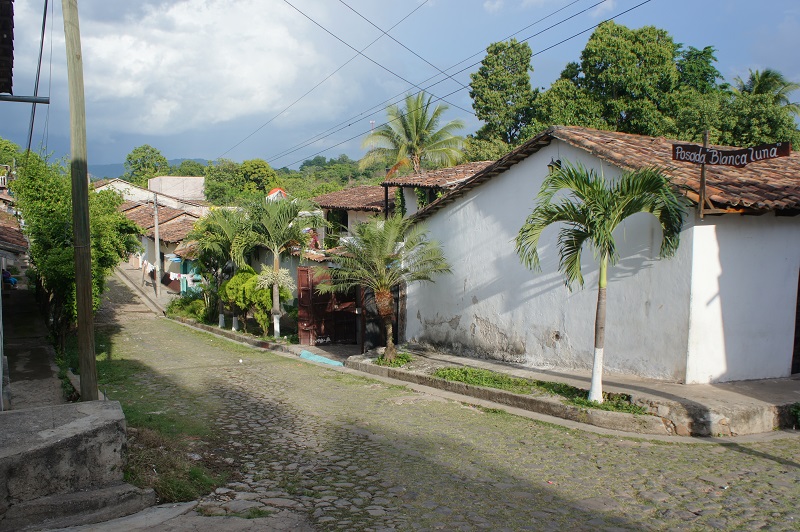
Hostal Blanca Luna, Suchitoto.
Rhys walking along El Tunco beach.
Me, El Tunco beach.
Rhys watching surfers from the top of a massive rock, El Tunco.
Me, El Tunco.

26 June 2013

Week 39 - Leon, Esteli, Matagalpa, San Salvador (Nicaragua, El Salvador)

We had a relaxed last day in Leon. Rhys got me to a agree to a Burger King for lunch before we headed to the Centro de Arte Fundación Ortiz Gurdián, a small art gallery composed of two restored, colonial buildings housing exhibitions of paintings, sculptures, images, and contemporary arts. After the gallery we wondered the streets for a while before Rhys headed back to the hostel and I popped out for a haircut. Later Rhys headed to the cinema to watch Superman in the air conditioned theatre as respite from the heat of Leon - we’re talking 34 Celsius minimum every day. That evening we headed to a bar for a few quite drinks with Charlie, an Irish guy who we went volcano boarding with.

The next day we left Leon and headed east to the central highlands and Estelí. Estelí isn’t the prettiest place in the world but apparently is a hotbed of political activity having seen heavy fighting and serious bloodshed during the Revolution. We checked in to a little hotel near the cathedral and after a brief wonder around town to orientate ourselves, stopped for a street food burger dinner. 

We were up early the following day (just after the air raid siren had gone off in the square, no idea what that was for) to catch a bus out to Somoto, a village 20km from the Honduran border. Having arranged a tour in Estelí, we were met by our guide at the bus station and piled in to a taxi to his house. We dropped off our bags, donned the wet shoes provided and jumped back in the taxi to the entrance of the Somoto Canyon national park. We spent the next 4 or so hours wading down river, hopping from boulder to boulder, swimming in the deeper bits and hurling ourselves off of the rock walls into the river below. I think the biggest jump I managed was about 12m with Rhys braving 16m. The canyon was extremely peaceful and beautiful, other than one family we didn’t see any tourists, just locals fishing. The trip ended with a short boat trip and a walk back to the guides house where we had lunch before grabbing a taxi back to the bus station and an express bus back to Estelí. 

Our next stop was Matagalpa, an hour and a half further east. Matagalpa has a prettier setting than Estelí, set as it is in the mountains, surrounded by bright green coffee plantations and alpine pastures. We spent the afternoon exploring the small town and sitting in a small coffee shop watching football on the TV.

Day two in Matagalpa we headed to the bus station for a bus to the Selva Negra, a stretch of pine clad mountains named by the area’s German immigrants in the nineteenth century after their homeland’s Black Forest. From the bus stop it was a 1.5km walk to the hotel where we paid our entrance and picked up a trail map. As it had rained during the night the paths were pretty muddy and at times were quite steep and overgrown but the forest was beautiful. We spent 3 hours walking 7km along a selection of the the trails listening to the birds and avoiding stepping on poisonous coral snakes before the heavens opened and we had to dive into the restaurant to avoid getting drenched. Rhys had found a small army of termites had made one of his hiking boots their home (they were literally covered in them, looked like the shoe was alive) so he hiked in his Etnies and ended up on the floor more than once as a result of the lack of grip and slippery slopes. After a disappointing cup of coffee (as a working coffee finca that apparently produces some of the best export grade coffee in the country, you would expect the coffee to be amazing), and a slice of cake the rain had subsided enough for us to walk back to the main road to wait for the bus. Unfortunately the bus stop was right next to a cock fighting ring and we had to spend 30 minutes watching truck loads of men rocking up to watch the ‘sport’, hearing the cocks crowing and listening to the spectators cheering.

We returned to Estelí at lunch time the following day and checked back in to the same hotel. Having already seen everything that we wanted to in town we spent the day catching up on emails and the like.

The week ended with an early start, having been awoken by the air raid siren and hundreds of fire crackers (they are obsessed with fireworks in Central America and set them off at any time of the day and anywhere) and a taxi to a petrol station on the InterAmericana where we sat for over an hour waiting for the Ticabus to turn up. A pleasant break from chicken buses we’d booked a Ticabus coach to San Salvador as we decided to skip Honduras altogether - not only because it meant we’d have more time in Guatemala and Mexico for where we’ve been hearing rave reviews from other backpackers but because we’d also heard a ridiculous amount of scare stories about how dangerous Honduras is at the moment with people walking the streets with guns and swords. Although a lot of people are still visiting the Bay Islands, because we don’t dive and we’re planning on spending time on beaches further north we decided we’d just race through on an international bus to El Salvador. 

The border crossings were a breeze with Ticabus organising all the practicalities for a small admin fee and the 2 hours we spent driving though southern Honduras made it look stunning and somewhere we wouldn’t be against coming back to when things have settled down in years to come. 

Once in El Salvador the bus went straight to San Salvador, the capital. From the drop off point we jumped in a taxi to the hostel we’d booked on line. We’d read reviews that it was hard to find but we weren’t ready for the hour it took the cab driver to find the place bearing in mind we were armed with an address, directions and a phone number. We finally got there after dark and were glad they served food onsite and the rooms were furnished with minibars so we didn’t have to venture out.
Massive tree, Selva Negra, Matagalpa.
Somoto Canyon, near Esteli.
Us looking snazzy in our life jackets, Somoto Canyon, near Esteli.
Me star jumping into the river, Somoto Canyon, near Esteli.

20 June 2013

Week 38 - Granada, Masaya, Leon (Nicaragua)

As the buses on Isla de Ometepe are few and far between we decided to jump on the back of a pick-up to get back to the port in Moyagalpa so we could make it to Granada before dinner time. We timed it perfectly and arrived in time to board the 11am ferry for the crossing back to San Jorge and the mainland. From there, we took a collectivo to the bus terminal/market in Rivas and onto a chicken bus for the final leg of the journey into Granada. On arrival we checked into a new hostel, whose owners we’d met on Ometepe. After saying hello to the resident monkey, we were straight in the pool to cool off. Since it was already early evening we only popped out to get our bearings and to buy hot dogs from the street stalls for dinner. Back at the hostel, Adrienne who we had met on the bus and a few people staying at out hostel sat in the bar until the early hours chatting and enjoying the rum and cokes.

The next day we were feeling a little worse for wears, we ventured out to an Irish bar, one of the most popular spots in Granada for lunch before heading back to the hostel to chill. Later that afternoon I left Rhys on the computer and headed into town to explore. Like every colonial town, the focus is the cathedral and Parque Central with colourful buildings lining the streets radiating from it. Every where you turn there are horse drawn carts decorated with an abundance of ribbons. My first stop was the Fuerte La Polvora, an 18th century fort that is a bit run down on the outside but has a peaceful little courtyard interior that you could peer into through the locked gates. My second stop was in an amazing little coffee shop opposite the Xalteva church where I whiled away a happy hour with a cappuccino and a copy of the latest issue of Monocle. Back towards the centre of town and I stopped to climb the bell tower of La Merced church only to get to the top to be deafened by the 4 o’clock bell ringing. A quick walk along the Calle La Calzada, the main street for bar and restaurants where tables and chairs spill out onto the pedestrianised road and a brief stop at the church San Francisco and I headed back to the hostel. After a quick dinner at a little local restaurant we turned in for an early night.

We had intended to spend the next day at Laguna Apoyo but unfortunately they need 4 people to run the shuttles and the other two who had signed up didn’t turn up. The cost of a taxi for two of us seemed steep so we decided on a chill day just relaxing at the hostel.

We left Granada on Saturday to head to Masaya, a little town 40 minutes away famed for its artisanal market. We checked in to a dirt cheap hostel for £4 a night for 2 people in a private room and went for a wonder around town and to check out the markets. If we were just on holiday and could bear the thought of carrying huge wooden bowls or paintings with us we could have spent a fortune but as it was we came away empty handed. Other than the artisanal market Masaya has little to offer tourists, the main market out by the bus stop is pretty dirty and confusing and after rain the pathways turned into mud tracks - you can however buy pretty much anything there should you want to.

Our second day in Masaya we were up early to catch a taxi to Volcan Masaya National Parque. From the entrance it was an easy 1.5km walk to the visitor centre where after a look at the exhibitions we arranged for a ranger to drive us the last 5km to the crater. Masaya continually emits large amounts of sulfur dioxide gas (from the active Santiago crater) and it’s quite impressive to see the smoke billowing out of the crater and up into the sky. A number of the viewpoints are currently closed after an eruption last year so we weren’t there for too long before the ranger drove us back to the entrance from where we flagged down a bus back into Masaya. Back at the bus terminal/waste land/market we jumped on another bus heading to Catarina, one of the ‘Pueblos Blancos’ - white villages so called for the white wash buildings and the white magic that used to be performed there. Catarina has a spectacular mirador overlooking the Laguna de Apoyo crater lake and to Lago Nicaragua with a number of volcanoes and mountains spreading out in the distance as far as the eye can see. Although you can walk down to the lake from here Rhys was a little under the weather and we settled for lunch at one of the restaurants overlooking the mirador. After lunch we wondered through the town which is full of craft stalls and plant nurseries, back to the main road for a bus back to Masaya. While Rhys stayed in the hostel for the rest of the afternoon I went back to the market to browse and sat in the main square people watching for a couple of hours.

We left Masaya the following day and caught a bus to Managua. From the bus terminal we jumped in a taxi across town to the shuttle bus stop for the drive to Leon. Sitting with our bags practically on our laps it was extremely uncomfortable but at least it was only an hour and a half. In Leon we got in a cycle taxi to Backpacker Street and checked in to a little family run hostel. We headed out for a quick wonder to the cathedral, the biggest in Central America and undergoing a face-lift after the most recent explosion of Cerro Negro coated it in black volcanic ash. On our way back to the hostel we bumped in to Adrienne from Granada and arranged to meet her at her hostel that evening for drinks.

The following day we booked to go volcano boarding with Bigfoot, the most well known hostel in Nicaragua and reputedly the owners of the fastest boards. The trip started with a 45 minute drive on the back of a truck though twisting dirt tracks out to Volcan Cerro Negro. Once there we began an hour long hike to the top at an elevation of 728m, stopping to peer into the crater and feel the heat of the ground. The volcano is the youngest in Nicaragua at only 160 years old and has erupted a staggering 23 times in it’s lifetime. It is a gravelly basaltic cinder cone black in colour and contrasts greatly with the surrounding verdant hillsides. The views from the top were breathtaking and you can see the Central American Volcanic Arc spreading out north to Honduras. At the top we had a quick guide on how to board before donning our orange jump suits and lining up to take it in turns to sit on our wooden plank, hold onto the rope and speed down the volcano. The experience is included on the CNN “Thrill seeker's bucket list: 50 experiences to try before you die” at number 2, second only to flying a jet plane. Now i’m not sure if it was that good but it was great fun, we didn’t come close to the 91kph record, Rhys reached the dizzy heights of 38kph and I clocked in at 41kph and it was all over before you’d really had a chance to master the technique but all the same I would highly recommend it. Back in town we enjoyed an included mojito before retiring to the shower to wash the volcanic rock out of our hair. That night we arranged to meet up with some of the people from our trip at a bar nearby and sat drinking half bottles of £2.25 rum until closing time.

View of Granada from La Merced bell tower.
The smoking crater of Volcan Masaya.
The Laguna Apoyo crater lake, outside of Masaya.
The biggest cathedral in Central America, Leon.
Hiking Cerro Negro, near Leon.
Rhys at the crater of Cerro Negro, near Leon.
Rhys in his snazzy jumpsuit ready to board Cerro Negro, near Leon.

12 June 2013

Week 37 - San Juan del Sur, Isla Ometepe (Nicaragua)

We left San Jose early doors and walked a kilometre to the office for the bus company heading to Penas Blancas and the Nicaraguan border. 5 hours later we were at the border and had a surprisingly easy crossing despite the confusing layout and lack of signage to tell you where to go and the stories of 2 hour crossings. We made it on to a Rivas bound bus just as a fight broke out at the bus stop, wondering what Nicaragua had in store for us. After we left the border our impression of Nicaragua instantly improved with the locals shouting at us to get off the bus at a cross road to catch the San Juan del Sur bus.

San Juan del Sur, is a cute little town on the Pacific coast full of hostels, bars and surf shops. Although the beach in town is decent enough, everywhere offers transfers to the surrounding beaches where the surf is supposed to be world class - we didn’t make it out of the town. The first afternoon, after a wonder around to get our bearings, we ended up at happy hour at one of the bars right on the beach to watch the sunset, you can’t turn down $1 beers and rum and cokes. Once happy hour had finished a storm drifted in and we ended up running through the streets, shoes in hand, ‘Tom Cruise’ style, to a little curry restaurant we’d spied earlier. Back at the hostel we were happy to see the electricity had finally come on having been off all day.

The next day we’d intended to head to a nearby beach but decided instead to relax in town. Rhys stayed at the hostel to fix the computer while I wondered around town and along the beach, amazed at all the driftwood brought in by the storm and the unusual sight of people actually clearing it (this never seems to happen in South America). In the afternoon we headed up to Pelican Eyes, one of the plushiest hotels in the area where rooms were completely out of price range at upwards of $180 a night, but where they let you pay a couple of dollars to use the infinity pool with views out over the bay. An amazing storm with ridiculous thunder and lightening started just as we got in from dinner.

We left San Juan del Sur as soon as we woke to catch the chicken bus (an old American School bus, normally pimped to the nines) to Rivas. We were dropped in a frenetic market area where we ended up paying over the odds for a cab to get us to the dock in San Jorge thinking there was a ferry at 11:30. The ferry didn’t leave until 12:30. We ended up spending an hour sitting on the rickety old wooden boat waiting for it to leave. By 2pm we had docked in Moyogalpa, the main town of Isla de Ometepe.

Isla de Ometepe is Lago Nicaragua’s largest island and a bit of a backpacker hub. The island is dominated by the cones of two volcanoes, the active Volcan Concepcion in the north rising to 1,610m and the dormant Volcan Maderas in the south, standing at 1,394m. It’s an incredibly laid back and peaceful place with just one road running as a ‘figure 8’ around the two volcanoes. On arrival we negotiated a taxi to take us from the dock in the main town across to the southern, quieter side of the island, to the small village of Balgue and Finca Magdelena. The Finca is an old hacienda, converted into an organic coffee co-operative. Using our new bargaining skills picked up from Fleur we managed to get a private room for a bargain $10 a night before heading back along the 1km track from the Finca to the village to an amazing little cafe, Cafe Campestre, for a delicious organic, fresh meal and to pick up an equally yummy packed lunch for the next day. Back at the Finca we settled down to watch the mesmorising sunset over Volcan Concepcion from the veranda enjoying bargainous rum and cokes. 

We were up early again the next day to meet our compulsory guide for a hike up the verdant slopes of Volcan Maderas, the smaller of the two volcanoes on the island and supposedly the easier walk. The volcano is clothed in cloud forest filled with monkeys, birds, and super loud cicada bugs and we were lucky enough to spot a brightly coloured venomous coral snake. The hike is supposed to take 7-8 hours. We managed it in 6 ¼ hours. It took 3 hours to walk to the crater lake, a pretty steep and slippery up hill slog followed by a 10 minute downhill in to the crater. The lake was covered in cloud when we got there and was very mystical but I wouldn’t say mind blowing. We ate our sandwiches before starting the return leg which was just as difficult as the uphill since it had rained a bit and we were scrambling over muddy, slippery boulders. It was a shame that the clouds were low so our views over Volcan Concepcion and the lake were limited but all the same it was worthwhile. As we got back to the Finca a storm hit, great timing! We spent the rest of the day eating cake, drinking coffee grown in the Finca and finishing the bottle of rum from the night before. 

We’d intended to walk into the village and catch the bus back up to Santa Domingo, a little stretch of hostels lining the islands main beach. That was until we found out that buses don’t run on a Sunday. We ended up calling a taxi which for the sake of ease was worth every penny. We checked into a little loft room just as another storm hit and apart from a short walk along the beach, spent the day at the hostel with lunch at a nearby comedor.

The rains continued all of the next day and ruined our plans of renting a scooter. Rhys hung around the hostel and I only ventured out for a short walk along the road and down a footpath before realising that plastic flipflops and ankle deep mud were a bad combo.

Luckily when we woke the following day the rain had subsided, we booked in to the hostel for another night and headed out to rent a scooter for the day. It took us about an hour to get up to the main port town in the north, Moyogalpa where we stopped at a great little cafe for lunch. Since we couldn’t take the scooter along the unpaved road we turned back the way we came. We made two stops, the first at a beach/mirador, Punta Jesus Maria where a spit of sand juts out into the lake from where you can see both volcanoes. Our second stop was at the museum. We haven’t been to a museum in ages and thought it would be worth a look, if you don’t speak Spanish I wouldn’t recommend it. It’s by guided tour only and there are about 4 rooms showing the history of Nicaraguan money and then another 4 rooms with archaeological finds from the island. Next we were back on the scooter to ride around to the eastern side of the northern volcano to the second largest town, Altagracia, before heading back south to El Ojo de Agua, two outdoor swimming pools in the forest filled with thermal spring water with medicinal qualities. We didn’t have swim wear with us so only stayed long enough to dangle our legs in before heading on to El Porvenir, a hacienda where for a small fee you can walk around the grounds and admire the ancient petroglyphs, swirling patterns and stylised animals carved in the basalt rocks. We ended the day back at the cafe in Balgue for an early dinner before returning the scooter.
Rhys in the pool at Pelican Eyes Hotel, San Juan del Sur.
Sunset over Volcan Concepcion from Finca Magdelana, Isla Ometepe.
Hiking Volcan Maderas, Isla Ometepe.
Storks on Santo Domingo beach, Isla Ometepe.
Riding our scooter, Isla Ometepe.
Petroglyphs, El Porvenir, Isla Ometepe.

5 June 2013

Week 36 - Pacuare Nature Reserve, Tortuguero, San Jose (Costa Rica)

We started the week at the north station of the Pacuare Nature Reserve, having written a lot of detail on the reserve last week I’ll concentrate on the highlights (and lowlights) in this week’s blog.

Alongside the activities I talked about last week, we also had the option of going out at 5am on the census, a walk of the beach in day light to make sure nothing was missed on night patrols, to count trails where hatchlings had hatched in the night and to check for any other activity. We went on one census in the north station and came across 4 hatched nests. A quick check of the top sand of the hatched nests (nests are about 50 – 70cm deep) for trapped hatchlings and we came across one who hadn’t made it out. He was so cute, a little dazed at first but he soon found his feet (flippers) and headed off to the sea, we named him Billy.

After 4 nights at the north station we packed our bags to head to the south station where we were due to stay for the remainder of our visit. After lunch we headed to the beach for a couple of hours to clear vines without any of the assistants bothering to join us. At 5pm we stopped work and headed to the hatchery – an area where some nests have been relocated for research purposes based on the temperature of the nests which determines the sex of the turtles. The nests were hatching and we were lucky enough to be there for the release of 13 hatchlings. They handed tiny hatchlings to us over the fence and pointed us to an area of shade where we could release them, for something so small they’re flippers were already pretty powerful and it was hard not trying not to drop them as they wiggled about. We let them go and watched as they made their way to the sea. You can’t help but laugh and smile as you see them go and getting wiped out with the first waves.

That night we’d asked to go on the 8pm patrol as all the turtles we’d seen so far had been out before midnight and the midnight shift is horrible messing with your sleep patterns. As soon as we started we noticed that the patrol was different with the assistant making constant contact with security with her torch and freaking when she saw a white light on the beach (assistants use red, poachers use white), it wasn’t until we reached the 3.5km mark where we met the patrol from the north station that we found out why. On a turtle project 30-40km along the coast an assistant had been shot by poachers while out on patrol with 4 foreigners. The assistants were shocked that we’d been kept in the dark and not having all the facts at our disposal we were angry and nervous about being on the beach. Fleur asked to be taken back to the station having had a bad experience in Colombia and we started back. Just when you least want it, we stumbled across a turtle and all agreed to stay with her until she was back in the sea. For an hour we all forgot about the shooting and were mesmerised by the turtle.

On the way back we bumped into Alvaro who was doing the midnight shift alone, closely followed by a security guard (where was our security guard?) and asked him why we weren’t told, he said we’d talk tomorrow and off we went to sleep on it. 

The next morning we had a meeting with Alvaro and Isabel after breakfast. We’d made up our minds that we wanted to leave, more because we didn’t want to create an awkward atmosphere than because we felt unsafe. Once we had all the facts I think me and Rhys would have gone on patrol anyway, the guy was singled out because he was petitioning for more police presence on his beach to stop poaching, it wasn’t a random shooting. The press release talks about drugs traffickers being unhappy that usually deserted beaches were being patrolled by environmentalists and that suggests that our beach could also have been at risk of attack. We were shocked that the team at the reserve had made the decision not to tell us, giving the reason that they wanted to keep things as normal as possible having spoken to the coast guard and the police and deemed there to be no risk – that doesn’t explain the increased security presence on the patrols that night, the reduced number of patrols (3 instead of 5) and the decision not to let anyone patrol alone! I am sure the Pacuare Reserve is a safe place for volunteers, it doesn’t border a town and access is difficult because the waves crash at the shore. There is a constant security guard presence watching the sea for boats and the poachers know this and no poachers have been seen on the beach at all this season – before the reserve was established, 98% of eggs were poached, now only 2% are poached. Poachers are far more likely to go to the beaches that can be accessed easily and where the patrls are understaffed. Our decision to leave the reserve was more based upon the way we’d been treated and not wanting to ruin such an amazing week by spending 2 days being awkward.

We caught a boat just before lunch for the 2 hour journey along the canal to Tortuguero. The boat trip was beautiful, winding through the waterways (which are more like murky rivers than British canals) surrounded by rainforest, spotting monkeys and birds along the way. The majority of the journey was actually through the Parque Nacional Tortuguero, an area which protects not only the canal and the surrounding forest but the stretch of beach that runs parallel and which is an important green turtle nesting site (Tortuguero translated means “Turtle Place”). The village itself was incredibly peaceful and despite it’s isolation with no road access (and so no cars) on a spit of land between the sea and the canal, it’s one of Costa Rica’s most popular spots, mainly because of the spectacular biodiversity. We were glad to be there before the green turtle season kicked in which meant the visitor numbers weren’t so high and it was quite peaceful.

After settling in to a hostel on the sea front with a great communal veranda (Fleur is amazing at bargaining the price down!) we headed for a beer by the canal before drinks at the hostel.

The next morning we were up at the crack of dawn to meet our guide, Castor, for a 3 hour canoe tour of the canals. There were 8 of us in the boat and only 4 oars so we had to take it in turns rowing while Castor steered us around the canals pointing out monkeys, Jesus Christ Lizards (they can actually walk on water!), caiman and lots and lots of birds. Back on dry land we had a nap before heading back into the National Park to walk the land trail along the coast. It wasn’t anywhere near as pretty as Cahuita but was full of lizards of all different shapes and sizes - you’d be upset if you paid your $10 entrance and only did the walk but it was worth it with the canoe trip in the morning.

As we got back to the hostel we found Fleur in a bad way, something had gone in her eye and scratched her cornea and James ended up calling 911 and rushing her back to the mainland to meet an ambulance to get her to a clinic - she’s on the mend now. 

We’d intended to leave the next day but decided to have a chill day, Rhys stayed at the hostel and I only ventured out to buy cake and browse the souvenir shops (not that we’re actually buying any souvenirs, souvenirs = more weight). James and Fleur got back early evening as we were enjoying a glass of wine on the veranda and joined us for cards and take out dinner. After spending the last month traveling on and off together and having shared the once in a lifetime turtle reserve experience it was sad to be saying bye to Fleur and James, although we hope that they’ll get bored with Costa Rica and head up to Nicaragua sooner than planned to catch us up.

We ended the week in San Jose having left Tortuguero on a boat to La Pavona docks an hour away and catching a bus to Cariari and another bus in to San Jose. Arriving late afternoon we jumped in a cab to the hostel I stayed at last time I was here with Mum - we stayed in the room next door, happy memories! (Miss you mum). Since San Jose doesn’t have much to offer and a storm was just starting we decided to make for KFC and then chill watching a movie in the hostel.

Hatchlings heading for the sea, Pacuare Nature Reserve.
Heron in Tortuguero National Park.
Canoeing in Tortuguero National Park.
Adult leatherback turtle heading back to the sea, Pacuare Nature Reserve.